

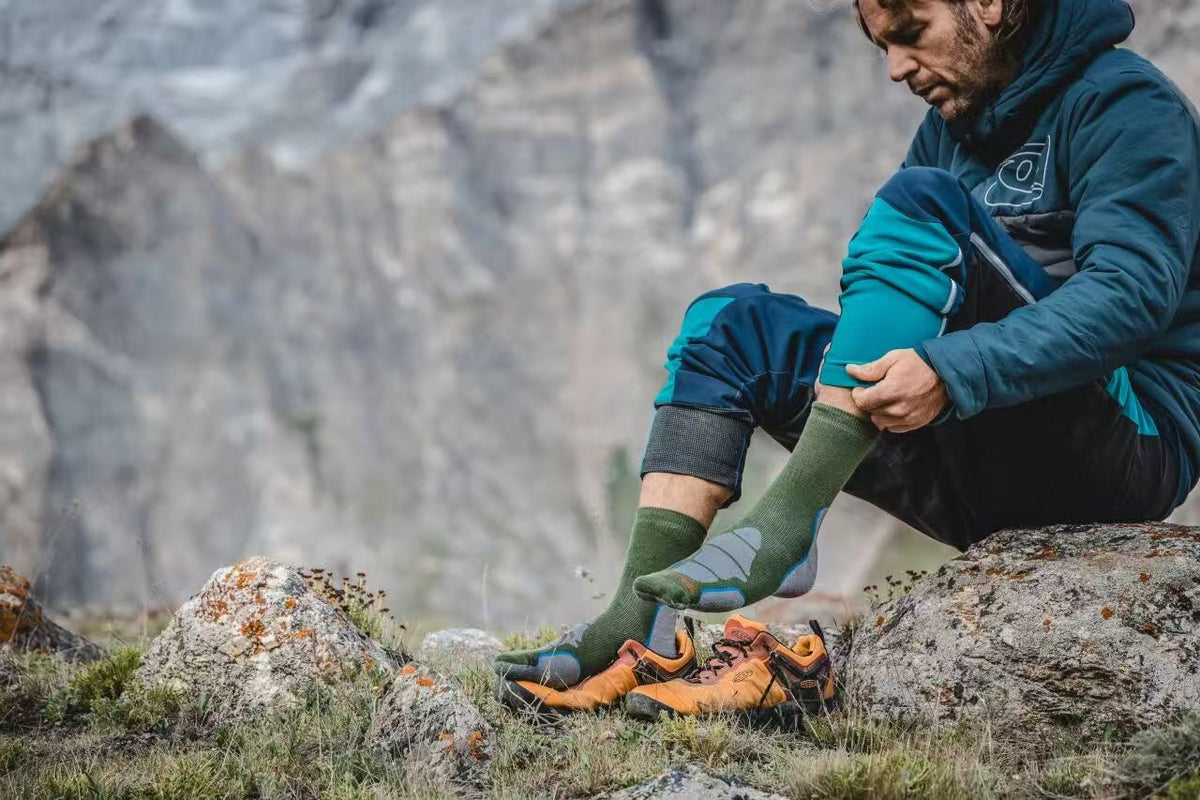
A good pair of wool socks helps your feet adapt, until they don't. On a long hike or trail run, one "best" pair rarely finishes the day. Feet keep sweating. After enough kilometers the cushioning drops, wet skin rubs harder, and even a well-made merino sock can feel like sandpaper. That is a common way blisters start.
This is not an argument against wool. It is an argument against asking one pair to do a two-pair job.
Wool is good at holding moisture in the fiber. That is a strength, until the sock no longer feels dry. In the field, around 35% of dry weight is a useful turning point to watch for, not a lab certificate. Wet skin also has more friction.
Wet socks run cold because wool stays warm by trapping still air. Water moves heat away much faster than air. Once moisture pushes that air out, a thicker sock does not fix it. A dry one does.
The rule: start dry. When the pair on your feet feels heavy, cold, or slick, change. Clip the wet pair to a daisy chain with a carabiner, or hang it in a light mesh bag on a trail run. Merino's lanolin helps with odor; once air-dried, that pair can go back on. Same rule for any next-to-skin layer. If that layer is soaked, a thicker shell will not bring the heat back.
Two pairs is the minimum. Two or three is better on a long day. Swap. Clip. Dry. Repeat.
If you are packing ZEALWOOD: Trail Run Pattern, Travel MD, Thule Pro (68.4% merino), Alpine Pro (63% merino), Ski with Z-CROSS. We do not call these 100% merino socks. The main yarn is wool; the finished sock still needs nylon and elastane to stay together on trail.
Wear Nature, Go Further.
ZEALWOOD